

Quick Answer: Neither Vanta nor Drata is the best choice for every company. Start with Vanta if your priority is a straightforward first-framework workflow and its integrations fit your systems. Give Drata close consideration when you need custom evidence pipelines and its audit workflow fits your team. Both support mature compliance programs. Choose through a practical trial with your actual systems, auditor, and quoted package, then assign the implementation work that software cannot own.
A customer is waiting for your SOC 2 report. You have two software proposals, two convincing demos, and a deadline that keeps getting closer. Both platforms promise to reduce evidence work, but neither proposal makes it obvious who will fix the access, device, and policy gaps underneath the dashboard.
That is where a Vanta vs Drata decision can go wrong: the team chooses the most polished demonstration before testing the work it actually needs to complete.
This guide compares the platforms across frameworks, integrations, auditor workflows, pricing, and AI. You will also get a practical way to test both and decide whether the bigger gap is software or implementation capacity.
BEMO is a certified Vanta partner and Vanta executive business partner, as well as a Drata partner. We deploy both and favor neither.
Our Vanta partnership and Drata partnership pair the software with managed IT, security, and compliance work.
Key Takeaways
- A framework logo does not show which controls, evidence, and features your proposed package includes. Check the exact entitlement and scope.
- Both platforms support customization. Drata's custom connections require development work; Vanta's custom tests also have feature and configuration limits.
- Test the auditor's view, not only the buyer's dashboard. Evidence must be visible, understandable, and tied to the right audit scope.
- Both vendors now use AI within compliance workflows. Drata's separate AI Agent Governance offering has limited availability, so verify what you can actually deploy.
- Compare software, implementation, internal effort, and external audit costs separately. A lower subscription price can leave more work with your team.
Vanta vs Drata at a Glance
|
Criterion |
Vanta |
Drata |
|
Best starting fit |
Connected workflows for a first framework or broader program |
Custom evidence pipelines and structured audit collaboration |
|
Frameworks |
Core security and compliance programs; verify package and scope |
Core security and compliance programs; verify package and scope |
|
Customization |
Custom frameworks and tests; check feature access and mappings |
Custom connections and tests on Advanced and Enterprise |
|
Published testing |
Hourly automated tests; verify source-data freshness |
Daily Autopilot plus on-demand tests; verify source-data freshness |
|
Auditor workflow |
Scoped auditor views and request management |
Audit Hub and auditor portal |
|
AI |
Policy assistance, guided flows, and recurring agents |
Compliance AI plus separate agent governance with limited availability |
|
Commercial check |
Personalized quote; confirm modules, limits, services, and renewal |
Personalized quote; confirm modules, limits, services, and renewal |
The strongest reason to prefer either platform is a demonstrated fit for your program. Brand recognition, a longer feature list, or a faster demo should not override a missing integration or an unstaffed control.
For a first SOC 2, Vanta is a sensible starting point when its standard workflows cover your stack and your auditor can work efficiently in it. Drata deserves an equally serious trial when custom evidence and control workflows are central. Neither recommendation excludes the other platform from that use case.
What Vanta and Drata Both Do
Vanta and Drata are governance, risk, and compliance platforms that help connect requirements, controls, and evidence. Both support programs such as SOC 2, ISO 27001, HIPAA, and ISO 42001, with package-specific access to frameworks and features.
Their overlapping capabilities include automated evidence collection, control monitoring, policy workflows, risk management, and audit collaboration. Both also offer trust-sharing and questionnaire capabilities that can help security teams answer customer requests.
For example, an identity integration can supply account information for a control check. The platform can identify a failure, connect it to a requirement, and help the team track the response. Someone still needs to decide whether the scope is correct and whether the underlying issue has been resolved.
Our guide to Vanta SOC compliance requirements explains the distinction between using a platform for readiness and completing the independent audit.
The shared baseline is substantial. The useful comparison is how each platform handles your exceptions, evidence sources, and operating model.
Where Each Platform Deserves a Closer Look
Vanta: Connected Workflows for a First Framework and Beyond
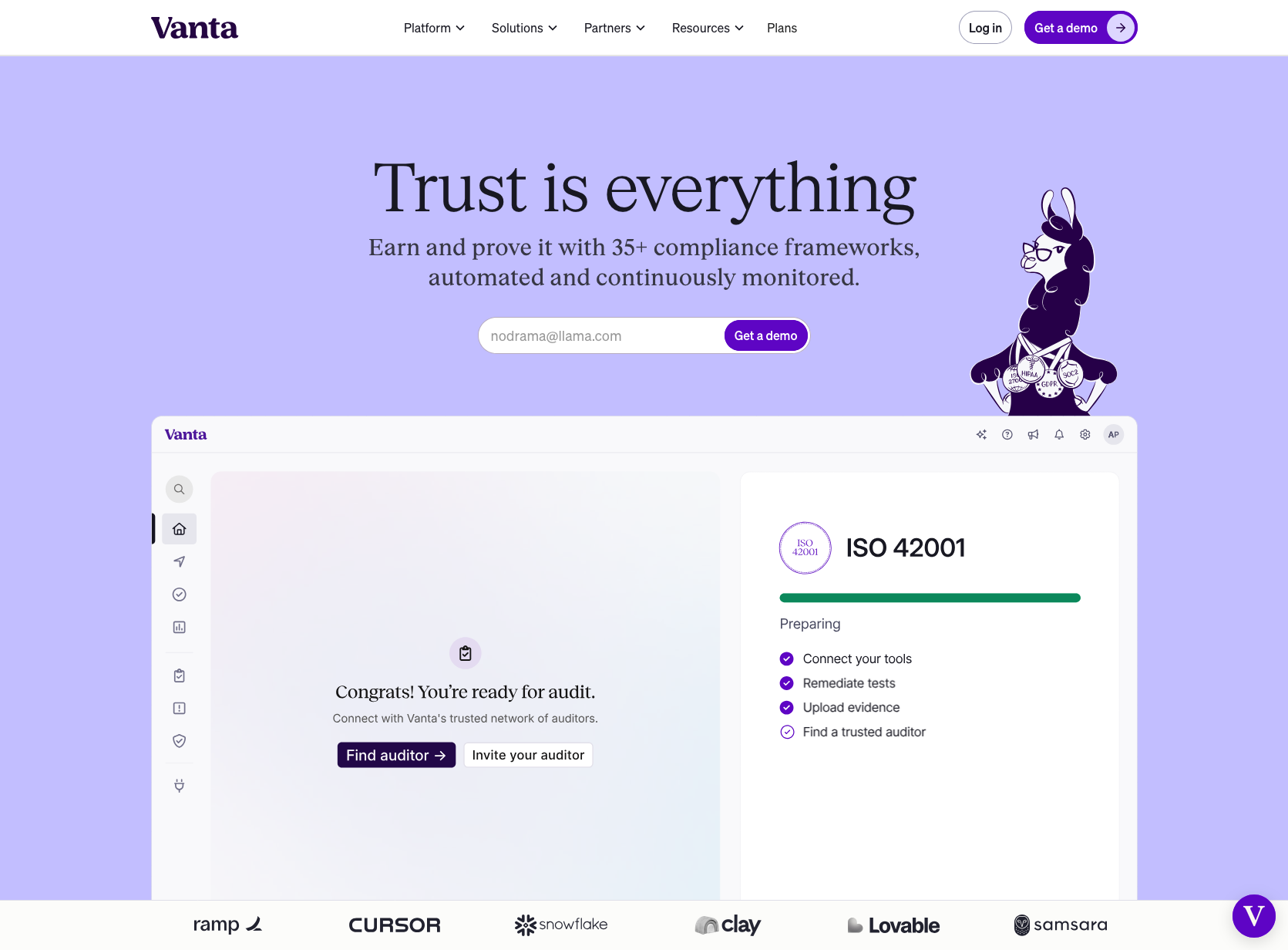
Vanta is worth an early demonstration when you want a connected path from systems and policies to evidence and auditor requests. Its current offering extends beyond first-audit preparation into risk, trust management, and broader compliance operations.
For a lean team, the practical attraction is having related work in one place. Test whether your team can connect its systems, understand failed tests, assign work, and answer an auditor's request without reconstructing the process in spreadsheets.
Vanta also supports custom frameworks and custom tests. It should not be dismissed as a fixed checklist that only works for startups.
There are details to inspect. Its custom-test documentation says tests must be tied to an integration, and copying a test does not carry over control mappings. The team must add those mappings and assign the owner and SLA category. Feature availability may require an upgrade or add-on.
Best reason to choose Vanta: Its actual integrations and workflow remove more of your team's recurring work in the proposed package.
Question to settle in the demo: Can we trace one failed test through remediation and into evidence our auditor can use?
Drata: Custom Evidence and Structured Audit Workflows
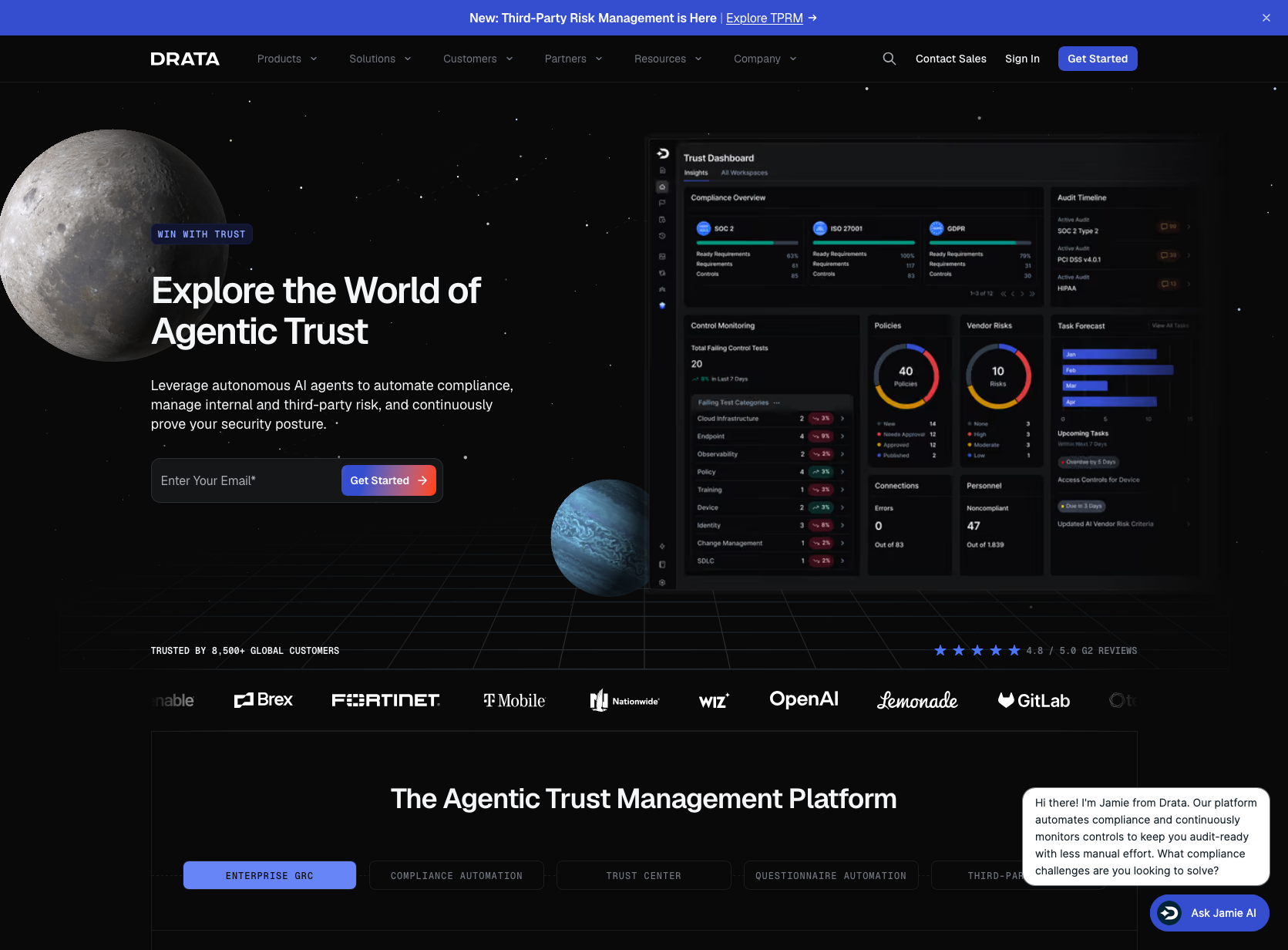
Drata deserves close attention when your program includes proprietary systems, custom checks, or controls shared across several frameworks. Its custom connections and tests provide a documented path for bringing structured evidence from external systems into the platform.
That flexibility comes with ownership. Drata's documentation places Custom Connections and Tests on Advanced and Enterprise plans and says customers must build the API workflow, configure data submission, and determine its cadence.
An engineering team can use that capability to reduce repeated manual evidence collection. It still needs someone to maintain the pipeline when the source system, data schema, or control logic changes.
Drata also provides Audit Hub and an auditor portal for coordinating requests and evidence. Those features are useful reasons to include your intended auditor in the evaluation, rather than assuming the buyer's view tells the whole story.
Best reason to choose Drata: Its custom evidence and audit workflows fit a real requirement, and your team has the capacity to maintain them.
Question to settle in the demo: Can we bring in one representative custom evidence source, test it, and show the result to an auditor without a manual workaround?
Compare the Criteria That Affect Your Program
Frameworks and Coverage
Start with the obligations you need to satisfy now and the next framework you expect to add. Check the version, control mapping, evidence requirements, and price for each.
Both vendors cover the familiar security and compliance programs. For specialized requirements such as FedRAMP or an industry-specific assessment, ask what is delivered: a pre-mapped framework, a configurable template, custom controls, or a separate service.
A platform's support for FedRAMP work is not the same as a FedRAMP authorization for your organization or the software service you are buying.
Cross-framework reuse can save effort, but shared labels are not enough. An access-review record may support several obligations only if its systems, review period, approvers, and level of detail fit each one.
Demo test: Choose one existing control and add a second framework. Have the vendor show what evidence carries over, what still needs review, and what new work is created.
Integrations, Evidence, and Test Cadence
An integration catalog is a starting point. The important question is whether the connector supports your exact product, tenant type, permissions, and evidence needs.
List the systems that matter to your audit: identity, endpoints, cloud infrastructure, code repositories, HR, and ticketing. For each, identify what data the platform imports and which checks that data supports.
Vanta documents hourly automated tests. Drata documents daily Autopilot runs with on-demand testing available. These are published schedules, not a measurement of how quickly your team will resolve a failed control.
A test can only evaluate the data available to it. A frequent check against stale input will not solve an integration problem. A prompt alert without an owner will not fix an access problem.
For a custom integration, include maintenance in the purchase decision. Ask who detects a broken data feed, how stale evidence is labeled, and what happens when the source API changes.
Demo test: Inspect a failed check, its underlying records, the last collection time, and the responsible person. Then show the path from remediation to a fresh result.
Auditor Experience
Both platforms have auditor workflows. Drata's named Audit Hub is not evidence that Vanta lacks audit collaboration, and a vendor's partner directory does not prove your chosen auditor will work more efficiently.
Vanta's documentation explains that auditor visibility depends on audit scope, the request list, and the selected auditor view. Drata likewise documents an auditor portal, evidence access, and audit request management.
Invite your prospective auditor to review the workflow before signing the software agreement. Ask how they request additional evidence, sample records, communicate questions, and retain the material needed for their work.
Demo test: Give the auditor a sample request and confirm that the evidence, explanation, and relevant history are visible from their account. Do not assume a note in the internal workspace is automatically visible to them.
Pricing and Renewal Terms
Both vendors direct buyers to personalized pricing and offer different packages and add-ons. Neither is universally cheaper, and their plan names are not equivalent scopes.
Vanta lists Essentials, Plus, Professional, and Enterprise. Drata lists Foundation, Advanced, and Enterprise across its GRC and assurance offerings. Confirm the exact product and package on each order form.
Request proposals against the same written requirements:
- The required frameworks, business units, and employee range.
- Custom tests, integrations, workspaces, and API capabilities.
- Risk, trust center, and questionnaire features and usage limits.
- Onboarding, implementation, support, and managed-service responsibilities.
- External audit fees and any other third-party costs.
- Renewal pricing, discount expiry, notice periods, and data export rights.
Then compare the full operating cost: software plus implementation, internal effort, ongoing support, and the audit engagement.
A discounted first year is useful only if you understand the later terms. Ask what happens when headcount grows or another framework is added, rather than assuming either vendor will keep the same price or raise it by a standard amount.
AI Features: Compare Specific Jobs and Availability
Both Vanta and Drata now apply AI to governance and compliance work. The distinction is more specific than saying one runs GRC while the other governs AI.
Vanta documents an agent for policy questions and guided compliance workflows. Its guided flows can take supported actions after confirmation, while access depends on user permissions and available features. It also documents custom agents for recurring work.
Drata publishes AI capabilities for policy-to-control mapping, test-failure explanations, questionnaires, and third-party risk assessments. Those are compliance-workflow features, separate from its AI Agent Governance product.
Drata labels AI Agent Governance as limited availability and says it is shipping first for Anthropic. If runtime agent discovery or policy enforcement matters to your purchase, verify the supported environment, access, and deployment requirements directly.
There is another distinction: managing evidence for ISO 42001 is not the same as controlling an AI agent's actions at runtime. Name the problem you need solved before comparing an “AI” line item.
Demo test: Ask each vendor to complete the same supported task using sample information. Inspect the source material, proposed action, permissions, review step, and activity record. Confirm which features are available in your quote today.
Which Should You Choose?
You Are Preparing for Your First SOC 2
Start with Vanta if its standard integrations and guided workflows fit your environment. Include Drata in the same evaluation, especially if your auditor already works effectively in it.
The deciding factor should be the work you can complete with your actual staffing. A first-audit team benefits from clear ownership and usable evidence more than features it will not operate.
You Have Custom Systems or Several Frameworks
Give Drata a detailed trial when custom evidence pipelines and shared control management are central requirements. Include the cost of building and maintaining those connections.
Test Vanta's custom frameworks and tests against the same requirements. Do not exclude it based on an outdated “startup tool” label, or assume Drata makes every custom integration effortless.
You Already Have One Platform
A failed implementation does not automatically justify a migration. First identify whether the problem is a missing capability, incorrect configuration, weak processes, or insufficient staff.
If the current tool can support the required workflow, repairing the program may be more useful than moving the same unresolved controls into another system. Switch when the alternative demonstrates a material improvement that justifies the transition effort.
Both Platforms Pass Your Evaluation
Choose the proposal with clearer implementation ownership, a workflow your team can maintain, and better total value for your scope. Avoid making a long-term operating decision on a small difference in the initial license quote.
What Neither Platform Can Own for You
Vanta and Drata can organize work, suggest mappings, generate drafts, and automate supported checks. The organization remains accountable for scope, risk decisions, accurate policies, implemented safeguards, and follow-through.
Consider an offboarding control. A dashboard may show that an account was disabled in the connected identity provider. Your team still needs to determine whether relevant access in other systems was removed and whether the evidence covers the actual offboarding process.
The problem is not the color of the dashboard. It is the difference between a test passing and the complete control operating as intended.
The practitioner discussion in r/cybersecurity shows why forum verdicts need context: participants describe different auditor experiences, support relationships, and commercial outcomes. Use those experiences to prepare questions, not to rank current products from years-old comments.
Neither platform issues your SOC 2 report. Under the AICPA's SOC reporting model, an independent CPA firm performs the examination and issues the report. For ISO certification, the relevant certification body makes the certification decision. Buying software or reaching a readiness percentage is not that decision.
Run the Same Practical Trial in Both Platforms
Give each vendor the same small set of requirements and sample data. Include a routine control and one awkward exception, such as a system without a standard integration.
- Connect a representative system and inspect the records received.
- Map a control to the requirement it supports, with an accountable owner.
- Record a failure, assign remediation, and capture the updated evidence.
- Show the auditor's view, including an additional evidence request.
- Export the evidence and relevant control information for review outside the platform.
Evaluate the complete path. Record where someone had to supply missing context, rebuild a spreadsheet, create a custom pipeline, or manually explain an ambiguous result.
That gives you a practical comparison of recurring effort. It also produces an implementation task list before the contract is signed.
The Part the Platform Choice Does Not Decide: Implementation
BEMO complements both platforms by managing the environment and operating work behind the evidence. We help configure Microsoft 365, identity and device controls, integrations, documentation, and ongoing compliance workflows.
The work should have explicit owners. The platform supplies supported monitoring and workflow capabilities. Your internal team or managed provider implements and maintains the controls. Management approves business decisions and risk acceptance. The independent auditor or certification body performs its own assessment.
Our managed approach also includes evidence cleanup, auditor coordination, and recurring control reviews. The scope depends on your framework, current environment, and service agreement.
If the trial reveals that nobody has time to remediate failures or maintain policies, that is a staffing and implementation problem to solve alongside the software purchase. Another dashboard will not assign that capacity for you.
Vanta vs Drata FAQs
Is Vanta or Drata Better?
Neither is better for every organization. Vanta merits a close look for connected, guided compliance workflows; Drata merits one for custom evidence and audit workflows. Both can support first audits and mature programs. Test your requirements in the exact package being offered.
Is Vanta Cheaper Than Drata?
There is no universal price winner. Compare quotes with the same frameworks, employee scope, modules, services, and term. Separate platform cost from implementation, internal work, and independent audit fees, and review renewal terms before signing.
Can You Migrate Between Vanta and Drata?
Yes, but do not assume every mapping, approval, comment, and history record transfers automatically. Inventory what must be retained, export and inspect it, confirm the destination's import options, rebuild connections, and validate controls with the responsible owners. Coordinate timing with your auditor to avoid disrupting an active evidence period.
Does Either Platform Issue a Certificate or SOC 2 Report?
No. Vanta and Drata support readiness and evidence workflows. An independent CPA firm issues a SOC 2 report; an appropriate certification body decides ISO certification. The software purchase is separate from those external engagements.
Do You Need a Managed Partner if You Have the Software?
Not always. A capable internal team can operate the program. A managed partner is useful when you need implementation expertise or recurring capacity for controls, evidence, and audit coordination. Confirm who owns each task instead of assuming support is included in the license.
Is Vanta Only for Startups and Drata Only for Larger Companies?
No. Both offer broader programs and customization. Company size is one input; framework scope, technical environment, audit workflow, staffing, and package limits are more useful selection criteria.
Turn the Comparison Into a Working Compliance Plan
Before choosing between Vanta and Drata, take one control through the full process: source data, test result, owner, remediation, and auditor review. Then compare the recurring work and full cost of operating it in each platform.
That exercise gives you a defensible choice and exposes the implementation gaps that need attention next.
Talk with BEMO about a compliance scoping assessment. We can help you evaluate either platform against your Microsoft environment, assign the work behind the controls, and build a program your team can maintain between audits.
We've got more resources for you to become a cyber-pro.

Leave us a comment!