

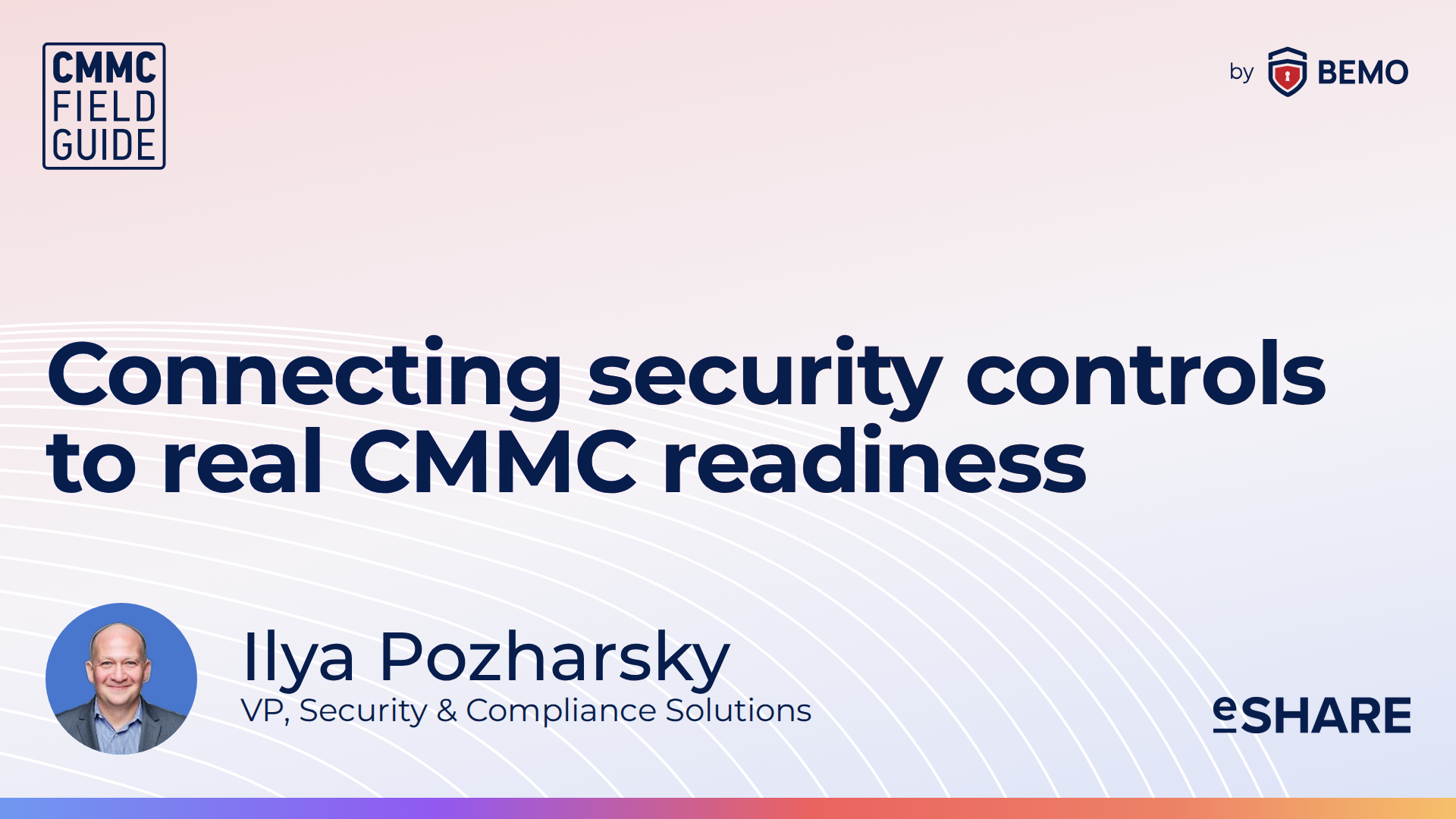
A security platform can support compliance without proving that the business is protected. Ilya Pozharsky, VP, Security & Compliance Solutions at eShare, explains how security and IT leaders can connect effective controls, everyday workflows, and ongoing evidence.
In This Field Guide
- The Technology Role: Support the Operation, Not Just the Control
- The Problem With “Compliance Chasing”
- Ilya’s Approach to Operational Readiness
- Why Stopping and Restarting Creates Its Own Work
- Where BEMO Fits
A control is documented. A platform is deployed. The project plan shows progress. But can the team explain whether that control protects the business, and show that it keeps working?
For defense contractors and other regulated organizations, that question connects two responsibilities that are often managed separately: securing the environment and demonstrating that the required work is happening.
Ilya Pozharsky brings a technology and security practitioner’s perspective to that connection. As VP, Security & Compliance Solutions at eShare, a secure external collaboration company, he works in a part of the ecosystem where protecting information has to coexist with getting work done.
In BEMO’s Security + Compliance Field Guide, his central distinction is practical: having a control in place and having an effective security operation are not the same thing.
The Technology Role: Support the Operation, Not Just the Control
Security technology provides capabilities. The organization still has to make those capabilities work within its actual processes.
That distinction matters when teams evaluate what a platform contributes to CMMC readiness. Buying technology does not answer every question about how a control operates, how the business uses it, or how the organization demonstrates that it continues to meet its obligations.
Ilya puts the boundary plainly:
“In the world that we live in today, having a great security platform by itself does not solve your problems either because we have our regulatory requirements and obligations as well.”
This is not an argument against technology. It is a reminder to evaluate technology as part of an operation rather than as a substitute for one.
For IT and compliance leaders, the useful question is not simply whether a capability exists. It is whether the capability protects the organization in practice and supports the proof the organization needs to provide.
The Problem With “Compliance Chasing”
Ilya calls out a familiar frustration: “compliance chasing.” It focuses attention on validating a checkbox without establishing whether the underlying control is effective.
A control might be running in monitor mode. It might generate substantial noise without identifying the threats that matter. Its presence alone tells the team little about the protection it provides.
“Effective controls mean that they actually protect the organization from the threats and risks that are apparent to them.”
The point is not that documentation is unimportant. It is that documentation and control effectiveness answer different questions. Evidence that a control exists should not become a substitute for understanding what it does.
The reverse is also true. Strong security technology does not remove the need to meet applicable requirements or demonstrate ongoing operation. Ilya argues for bringing those responsibilities together, rather than choosing one over the other.
Ilya’s Approach to Operational Readiness
Ilya’s guidance points to four connected operating principles. They are a way to organize his advice, not a separate certification framework or a replacement for evaluating specific requirements.
1. Understand the Work Before Deciding How to Secure It
The organizations Ilya has seen get ahead on security build close relationships with the business. They create liaisons and learn how people actually do their jobs.
“The organizations that I see, not that can get ahead right now, the ones who I’ve seen from my experience who have already gotten ahead, are the ones that partner with the business.”
He makes that partnership concrete: understand what engineers, sales representatives, and people on the manufacturing floor have to accomplish each day.
That context changes the security conversation. Instead of treating a workflow as an abstract system to restrict, the team can understand what needs protecting and where a control could make necessary work harder.
Ilya describes the goal as understanding “the best way to secure those processes and the business without impacting it negatively.” For a team deciding where to begin, an existing business workflow provides a more useful starting point than a control considered in isolation.
2. Evaluate Protection, Not Just Presence
Once the team understands the work, it can ask a more precise question about its controls: do they address the threats and risks the organization actually faces?
Ilya’s examples show why the distinction matters. A deployed control can still be limited by its operating mode or by signals that create noise rather than useful detection.
The practical lesson is to examine how the control behaves, not stop at confirming that it was installed. A project milestone can record deployment, but it cannot, on its own, establish effectiveness.
This is where implementation and readiness need to stay connected. The organization needs to understand both the protection being delivered and the evidence required to demonstrate its operation.
Are your controls deployed, but their ongoing operation harder to explain? Start a conversation with BEMO about connecting implementation, evidence, and assessment readiness. Explore BEMO’s compliance services.
3. Make Ongoing Operation Demonstrable
Ilya’s definition of a control includes more than the technology itself.
“When I talk about controls from a security perspective, I do mean the full operation of security, not just being able to have a control checkbox in place.”
That broader view brings continuity into the picture. The organization needs effective controls, but it also needs proof that those controls remain in place and that operations will sustain them.
Reporting is part of that connection. As Ilya explains, the ability to report helps teams validate that they are continuously doing the work and meeting their obligations.
For leaders reviewing progress, this changes what a useful update looks like. Deployment matters, but the conversation also needs to cover continued operation and the evidence available to support it.
4. Keep Useful Security Work Moving Through Uncertainty
Questions about regulatory timing can complicate planning. Ilya’s advice is to keep the purpose of the work in view:
“Do what is right.”
He explains that advice in terms of creating the operational processes needed to secure the business. Those processes have value beyond a single assessment milestone.
That does not mean general security improvements automatically satisfy every CMMC requirement. Teams still need to determine which obligations apply and what evidence is required. The distinction is between adjusting a plan in response to a specific change and letting uncertainty stop useful security work altogether.
In discussing audit timing, Ilya also stresses that a change in audit requirements should not be treated as proof that an organization’s existing security obligations have disappeared. Before changing direction, understand what actually changed.
Related clips:
- How to Prepare for CMMC Without Knowing What’s Next
- The CMMC Pause Doesn’t Mean Your Obligations Disappear
Why Stopping and Restarting Creates Its Own Work
For smaller organizations, pausing a compliance project is not simply a matter of leaving the plan untouched until later.
Ilya points to limited IT and security resources. Those people have already taken steps toward meeting requirements and have plans for the remaining work. A change in direction means deciding how to reallocate that capacity and what happens to work already underway.
“These companies need to now figure out how to not just pause and refactor their resources,” Ilya says, before asking, “how do you pick up where you left off?”
That restart question belongs in the original decision. Who will be available? What will need to be revisited? How will the team resume the plan after resources have moved elsewhere?
Ilya does not attach a dollar figure or a guaranteed assessment outcome to this advice. The consequence he identifies is operational: stopping, reallocating people, and restarting all create coordination work.
Keeping effective security processes operating can preserve useful progress. It also keeps the focus on what the business needs to protect, rather than making every improvement dependent on the next audit milestone.
Where BEMO Fits
The lesson is not to choose between security and compliance. It is to make protection, daily operation, and evidence support one another.
For defense contractors and federal-adjacent organizations, that takes coordination. Leadership needs visibility into the plan. IT needs practical implementation guidance. Compliance teams need evidence that reflects how controls actually operate.
BEMO’s role as a trusted integrator connects implementation, assessment readiness, and ongoing compliance. That approach aligns with the operating challenge Ilya describes: technology matters, but it needs to sit within a process the business can use, sustain, and demonstrate.
Build readiness around how your business actually works. Explore BEMO’s compliance services to discuss a practical path from implementation to ongoing operation and assessment preparation.
Frequently Asked Questions
Does Deploying a Security Platform Mean We’re CMMC Ready?
No. Ilya distinguishes between having security capabilities and meeting the organization’s broader obligations. Teams still need to evaluate control effectiveness, sustain operation, and provide the evidence required for their applicable requirements.
Where Should We Start When Controls Create Friction for Employees?
Start by understanding the workflow with the people who carry it out. Ilya points to relationships with engineers, sales teams, and manufacturing staff as a way to understand how to protect business processes without negatively affecting the work.
What Should We Consider Before Pausing Compliance Work?
Determine which requirements actually changed and which obligations still apply. Then account for the resources and planning needed to resume the work, not just the immediate effect of stopping it. Ilya’s warning is that a pause creates its own coordination challenges for teams with limited capacity.
We've got more resources for you to become a cyber-pro.

Top 10 Posts
-
Office 365 MFA Setup: Step-by-Step Instructions
-
CMMC Phase 2 Suspended: What the Compliance Pause Changed
-
Google Workspace to Office 365 Migration: A Step-by-Step Guide
-
How Much Does ISO/IEC 27001 Lead Auditor Certification Cost in 2025?
-
SharePoint vs. OneDrive (What's the Difference Again?)
-
What is The CIA Triad?
-
What is Microsoft Purview ? Your A to Z Guide to Getting Secure Fast
-
How to Migrate from GoDaddy to Office 365
-
How to Set Up Office Message Encryption (OME)
-
Who Needs ISO 27001: Is This Critical Security Certification Right for Your Business?
Leave us a comment!