

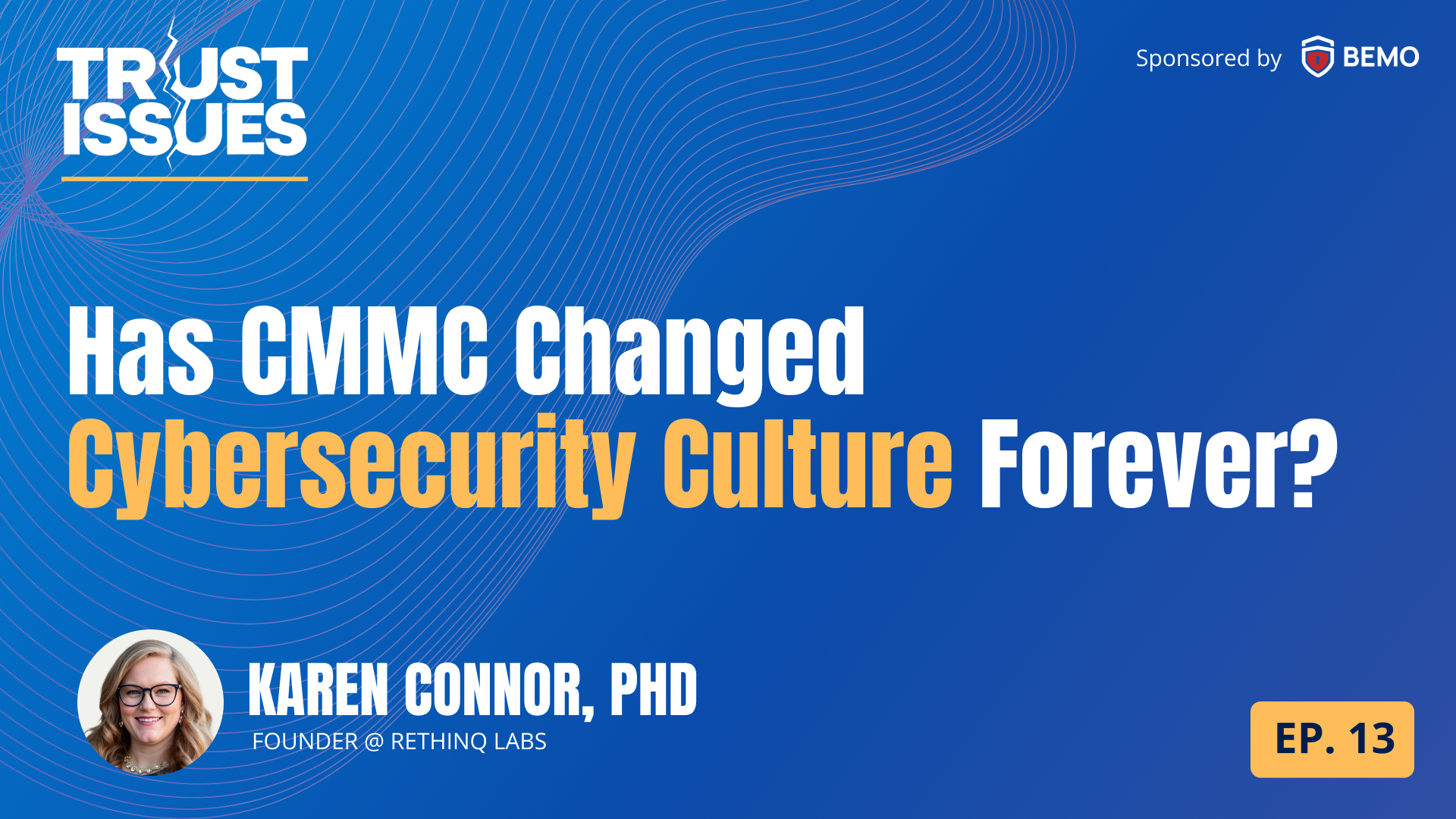
Quick Answer: Many organizations approach CMMC as an IT initiative, but successful CMMC readiness requires participation across the entire business. In this episode of Trust Issues, Dr. Karen Connor explains why compliance failures are often caused by unclear processes, weak security culture, and lack of executive engagement rather than missing technology. True readiness comes from understanding how Controlled Unclassified Information (CUI) moves through the organization and making security part of everyday business operations.
Key Takeaways
- CMMC readiness requires organizational change, not just technical controls.
- Compliance is everyone's responsibility, not solely the IT department's.
- Understanding how CUI flows through the business is essential.
- Poorly defined CUI boundaries can create unnecessary compliance risks and costs.
- Executive buy-in is critical for long-term compliance success.
- Cybersecurity should have the independence to raise business risks effectively.
- Self-certification can create a false sense of readiness.
- Organizations must treat security as a core business function rather than an audit exercise.
Table of Contents
- Why CMMC Is More Than an IT Project
- Why Not Knowing Can Be a Strength
- CMMC Is Everyone's Responsibility
- The Challenge of Defining CUI Boundaries
- Executive Buy-In Is Non-Negotiable
- CMMC Is About Business Resilience
- Should Cybersecurity Report to the CTO?
- The Risks of Self-Certification
- Making CMMC a Binary Decision
- Listen to the Full Episode
- Frequently Asked Questions
Why CMMC Is More Than an IT Project
For many federal contractors, discussions about CMMC readiness begin with a familiar response:
"IT is handling it."
However, as Dr. Karen Connor explains, this mindset is often where organizations run into trouble.
CMMC is not simply a technical project, a collection of policies, or a documentation exercise completed before an assessment. It requires organizations to understand how security practices affect daily operations across departments, workflows, and leadership teams.
Compliance is ultimately about how the business functions, not just how technology is configured.
Why Not Knowing Can Be a Strength
One of the most valuable traits Karen sees in organizations is the willingness to acknowledge uncertainty.
Companies that say, "We don't know what we don't know," are often better positioned to improve because they recognize gaps before they become assessment findings.
That honesty encourages organizations to examine how Controlled Unclassified Information (CUI) moves through the business, identify weak points in processes, and challenge assumptions about who owns security responsibilities.
CMMC readiness begins with understanding reality, not assuming compliance already exists.
CMMC Is Everyone's Responsibility
While IT teams play an important role in implementing and maintaining controls, they are only one part of the compliance picture.
Human Resources, Finance, Operations, Executive Leadership, Project Teams, and Customer-Facing Employees may all interact with systems, information, or workflows that impact compliance.
If employees regularly handle CUI but do not understand how it should be stored, shared, transmitted, or protected, the organization faces risk regardless of how much security technology has been deployed.
Many compliance failures are not caused by malicious intent.
They occur because employees are performing routine work within unclear or poorly defined processes.
Effective CMMC readiness requires ensuring every relevant team understands its role in protecting sensitive information.
The Challenge of Defining CUI Boundaries
One of the most common CMMC challenges involves establishing the proper CUI boundary.
Some organizations define the boundary too broadly, bringing large portions of the business into scope. While this approach may feel safer, it often increases costs, complexity, and administrative burden.
Others define the boundary too narrowly, assuming only a handful of employees or systems interact with protected information.
In reality, data frequently moves between teams, projects, vendors, and systems in ways organizations do not fully anticipate.
When that happens, the organization may unintentionally expand its compliance scope without realizing it.
Creating an effective CUI boundary requires a clear understanding of actual business processes and data flows rather than assumptions.
Executive Buy-In Is Non-Negotiable
Technology alone cannot create a compliance culture.
Leadership sets the tone.
Dr. Connor emphasizes that executive commitment is essential for successful CMMC readiness. If leaders treat security requirements as optional, inconvenient, or something to bypass for efficiency, employees often follow the same example.
When leaders consistently follow established processes, respect security controls, submit requests through approved channels, and reinforce expectations, compliance becomes part of how the organization operates.
Culture is built through behavior, and employees often take cues from leadership.
CMMC Is About Business Resilience
Organizations often frame CMMC as a requirement for winning or maintaining government contracts.
While true, that perspective can be limiting.
A stronger way to view CMMC is as a business resilience initiative.
Weak security practices can put customer relationships, contract eligibility, business reputation, and long-term growth at risk. Strong security practices help organizations operate more reliably, reduce risk exposure, and protect the information entrusted to them.
CMMC readiness is not simply about passing an assessment.
It is about building a business capable of operating securely over time.
Should Cybersecurity Report to the CTO?
Another topic discussed during the episode is organizational structure.
Dr. Connor challenges the common assumption that cybersecurity should always report through the CTO.
When cybersecurity is fully embedded within technology or product functions, competing priorities such as delivery deadlines, operational efficiency, and revenue-generating initiatives can sometimes overshadow security concerns.
Cybersecurity leaders need the ability to raise risks objectively, even when recommendations may be inconvenient for the business.
That often requires direct visibility and communication pathways with executive leadership.
The exact reporting structure may differ between organizations, but security functions must have sufficient independence to effectively advocate for risk management.
The Risks of Self-Certification
One of the biggest dangers facing organizations is false confidence.
Policies can be written.
Documentation can be completed.
Assessment artifacts can be assembled.
However, those efforts mean little if they do not reflect how employees actually work.
Organizations that rely solely on self-certification may discover significant gaps when assessors begin asking employees about their day-to-day responsibilities, workflows, and security practices.
True readiness requires validating processes before an assessment takes place.
That includes reviewing workflows, testing controls, confirming documentation accuracy, and ensuring employees understand their responsibilities.
Making CMMC a Binary Decision
The episode concludes with a simple but important challenge.
Organizations must decide whether they are fully committed to the operational, cultural, and leadership changes required to achieve sustainable compliance.
Partial commitment often produces partial results.
Successful CMMC programs require organizations to embrace security as a long-term business discipline rather than a one-time compliance project.
When it comes to protecting sensitive information and maintaining trust within the defense industrial base, there is no halfway version of readiness.
Trust is earned through consistent action.
Ready to Build a Security-First Culture?
Achieving CMMC readiness requires more than policies and technology. It requires organizational alignment, executive commitment, well-defined processes, and a clear understanding of how CUI flows throughout your business.
👉 Book a meeting with BEMO's compliance experts to discuss your CMMC readiness strategy.

Want more insights from compliance leaders and cybersecurity experts? Subscribe to the Trust Issues podcast for practical discussions on CMMC, cybersecurity culture, risk management, and government contracting.

Frequently Asked Questions
What is CMMC readiness?
CMMC readiness is the process of preparing an organization to meet cybersecurity and compliance requirements for protecting federal contract information and Controlled Unclassified Information (CUI).
Is CMMC only the IT team's responsibility?
No. Successful compliance depends on how employees across multiple departments handle information, follow procedures, and support security requirements.
What is a CUI boundary?
A CUI boundary defines where Controlled Unclassified Information resides, how it moves throughout the organization, and what systems, users, and processes are responsible for protecting it.
Why do organizations struggle with CMMC assessments?
Common challenges include unclear data flows, weak executive support, inaccurate documentation, lack of employee awareness, and security programs that do not reflect actual business operations.
Why is executive buy-in important?
Leadership establishes organizational priorities and influences employee behavior. Strong executive support helps ensure compliance efforts remain sustainable and effective.
How can organizations improve CMMC readiness?
Organizations can improve readiness by mapping data flows, defining CUI boundaries, training employees, validating controls, conducting internal assessments, and fostering a security-focused culture across the business.
We've got more resources for you to become a cyber-pro.
Leave us a comment!