

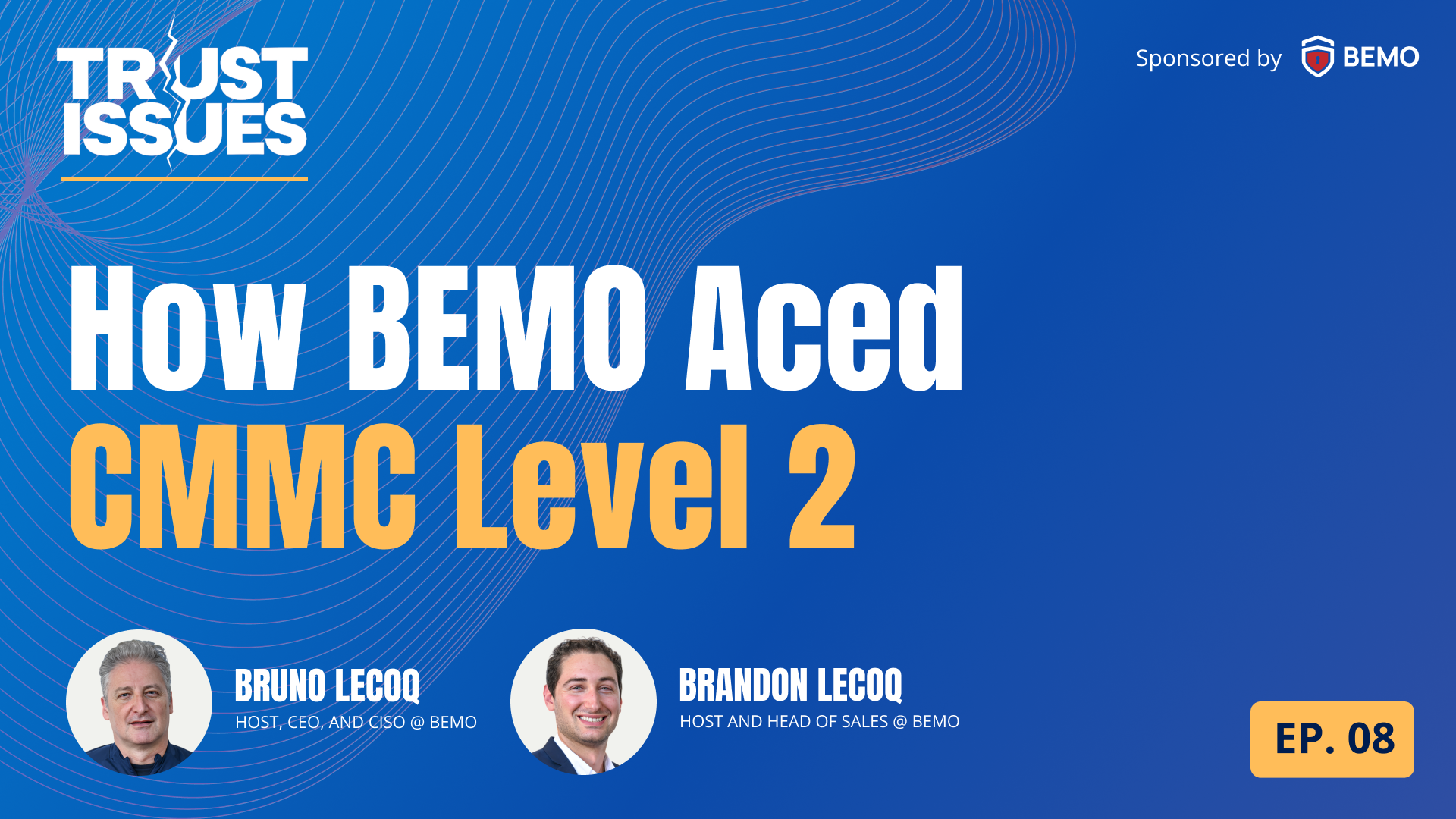
Most organizations approach CMMC Level 2 certification with the wrong question. They ask: What do we need to pass the audit? But the better question is: Are we actually operating in a way that deserves to pass?
That distinction sits at the heart of Brandon and Bruno Lecoq’s conversation on Trust Issues, where they unpack what it really takes to move from “we think we’re compliant” to “we can prove it under assessor scrutiny.” And the reality is far more demanding than many defense contractors, SMBs, and MSSPs expect.
Listen now:
👉 Apple
👉 Spotify
Priority #1: The Mock Audit
The biggest lesson from this conversation is that the mock audit is not optional.
For BEMO, the mock audit ran for five full days, from 7 AM to 3 PM Pacific, walking through the full scope of controls, evidence, policies, and procedures. Their IT controls held up, but they still uncovered five documentation issues that could have caused failure in the official assessment.
That should be a wake-up call.
Critical (Dumb) Mistakes to Avoid
Many companies assume compliance failure comes from glaring technical gaps: weak passwords, missing MFA, unmanaged devices, or incomplete access controls. But in CMMC, failure can also come from misalignment.
One of the biggest misalignments? The policy-procedure gap. A policy says one thing, a procedure says another, the evidence does not prove either clearly enough, and suddenly, a control that is technically implemented becomes an audit risk.
This is where CMMC exposes the difference between having documentation and having defensible documentation.
BEMO’s Operational Discipline
BEMO’s preparation involved 36 policies, 46 procedures, more than 700 pieces of evidence, and a 300-page System Security Plan. Across that volume, every statement has to connect. Every procedure has to support a policy. Every piece of evidence has to prove that the process is actually happening.
That is not just paperwork; it is operational discipline.
CMMC is Everybody’s Job -Not Just IT
One of the most important takeaways from the episode is that CMMC is a cross-functional responsibility. IT may own many technical controls, but HR, compliance, operations, leadership, and external service providers all play a role. During an audit, each team has to understand the policies and procedures they are responsible for. An MSSP can support the process, but it cannot represent the entire organization.
That matters because assessors are not looking for performance theatre. They are looking for proof that the business understands how it operates, how it protects controlled unclassified information, and how it maintains those protections consistently.
No Scope, No Hope
This is also why scope matters so much.
Some organizations try to shrink the audit boundary into something unrealistic: one laptop, one user, one tenant, one artificially clean environment. But C3PAOs are trained to spot that kind of thinking. If the boundary does not reflect how the organization actually works, it will not survive the scoping conversation.
In other words, you cannot game your way into maturity. You have to build it with intention and strategy.
Your Certification Becomes Your Customers' Risk
For MSSPs, the stakes are even higher. If you support defense contractors, your own compliance posture can directly affect your customers’ ability to pass. That turns CMMC from an internal certification effort into a business-critical trust signal. Your controls, evidence, processes, and reporting become part of your customer’s risk ecosystem.
This is where CMMC starts to look less like a government requirement and more like a competitive standard.
The Bottom Line
Yes, it is demanding. Yes, it adds work. Yes, it forces uncomfortable levels of documentation, ticketing discipline, evidence management, and process ownership. But it also creates something many organizations claim to want: a security program that is repeatable, auditable, and resilient.
CMMC Level 2 is not just about passing an assessment. It is about proving that your organization can operate securely when the stakes are real.
The companies that treat it like a checkbox will struggle through every policy review, every evidence request, and every assessor question. The companies that treat it like an operating model will walk away with something far more valuable than certification -they will have a business that is harder to break, easier to trust, and better prepared for the future of regulated work.
Frequently Asked Questions:
1. Why is a CMMC mock audit important?
A mock audit gives organizations a risk-free opportunity to uncover documentation, evidence, and control gaps before the official assessment.
2. Can strong IT controls still fail a CMMC audit?
Yes. Even if the technical controls work, misaligned policies, procedures, or evidence can still create audit findings.
3. Is CMMC Level 2 primarily an IT responsibility?
No. HR, compliance, operations, leadership, and IT all need to understand and own their parts of the compliance process.
4. Why does scoping matter so much in CMMC?
Your scope defines what systems, people, and processes are assessed, so unrealistic or artificially narrow boundaries can be rejected early.
5. Do MSSPs need CMMC Level 2 certification?
If an MSSP supports defense contractors handling CUI, its own compliance posture can directly impact the customer’s audit readiness.
6. What is the biggest mistake companies make with CMMC preparation?
Many companies assume having documents means they are compliant, when assessors are really looking for consistent, provable, operational evidence.
We've got more resources for you to become a cyber-pro.

Top 10 Posts
-
Office 365 MFA Setup: Step-by-Step Instructions
-
CMMC Phase 2 Suspended: What the Compliance Pause Changed
-
Google Workspace to Office 365 Migration: A Step-by-Step Guide
-
SharePoint vs. OneDrive (What's the Difference Again?)
-
How Much Does ISO/IEC 27001 Lead Auditor Certification Cost in 2025?
-
What is The CIA Triad?
-
What is Microsoft Purview ? Your A to Z Guide to Getting Secure Fast
-
How to Migrate from GoDaddy to Office 365
-
How to Set Up Office Message Encryption (OME)
-
Who Needs ISO 27001: Is This Critical Security Certification Right for Your Business?
Leave us a comment!